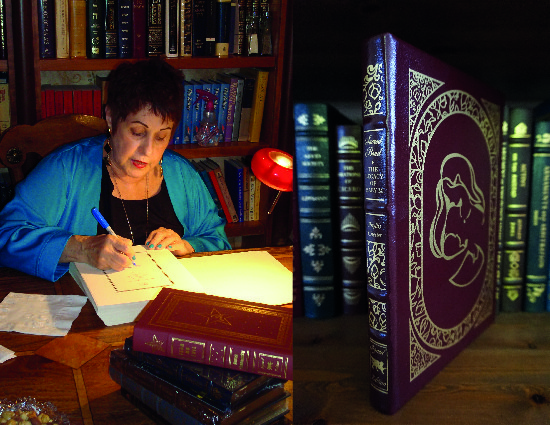
Lila Abu-Lughod: Another Self-Identified Palestinian
The Way to Succeed in Academia
Jul 28, 2026
Being pro-Palestine, or better yet, presenting oneself as a Palestinian, is a form of academic opportunism, at least in the West. One cannot exaggerate how pervasive this is.
The overly influential Edward Said did so with impunity, and he allowed the world to view him as a dispossessed and therefore heroic Arab Muslim Palestinian. As I've previously noted, Said was a dhimmi, a Christian who came from a very wealthy family. Said identified with the aggressors just as so many Westerners are currently doing.
Lila Abu-Lughod is another such academic climber. Is Abu-Lughod an Arab and/or a Palestinian? Is she a Muslim?
Lila Abu-Lughod's father, Ibrahim Abu-Lughod, was born in British Mandatory Palestine (in Jaffa). However, both he and his family left for good in 1948, long before Lila was born. Thereafter, Ibrahim graduated from the University of Illinois and taught at many American universities for nearly forty years. He became a prominent pro-Palestinian academic.
However, Lila Abu-Lughod's mother—her mother!!!—was a Jewish American sociologist, Janet Abu-Lughod (nee Lippman), which automatically makes Lila a Jew, at least in the eyes of Jewish law. Her daughter nevertheless identifies herself as a Palestinian-American (or allows others to make that assumption). She does not identify herself as a Jew, not even as a Jewish-American Palestinian. Her tie to "Palestine," through her father, is no more a credential than being born a Jew is a qualifier for one's non-scholarly views on Israel-Palestine.
At least Lila has studied Arab Muslim and Bedouin communities and has spent some time in Egypt doing research. However, she does not approve of Western feminists who dare to care about the women of Afghanistan, Iran, or Saudi Arabia. According to her, we have no right to "judge" what we cannot possibly understand; our attempts to do so lead only to "Islamophobic," racist views of a Western-occupied people.
On October 25, 2010, at the American University of Beirut, Abu-Lughod admonished (Western) feminists who “sensationalize” honor killings. She warned “that an obsessive focus on so-called honor crime(s) may allow scholars and activists to ignore important contexts for violence against women: social tensions; political conflicts; forms of racial, class, and ethnic discrimination; religious movements; government policing and surveillance; and military intervention.”
I strongly disagree. Based on my own four studies on honor killing, and my interviews with those women who escaped being honor killed, this ugly practice is not due to any political conflict or military intervention. It seems to be indigenous to the region and may have preceded Islam. I hold all religious leaders responsible for not attempting to find ways to abolish such femicide.
What kind of feminism does Abu-Lughod represent? She is a post-colonial, postmodern, multicultural relativist; a professor who does not believe in universal standards of human rights. Like Sunera Thobani, Abu-Lughod's work primarily serves the cause of one nationalism—Palestinian—and one tradition only—Islam/Islamism.
Another Lila—this time spelled Leila Ahmed, an Egyptian American-born feminist—has defended both the Veil and Polygamy within Islam. Accepting Muslim societies as they are, she explains that veiling allows an "upwardly professional woman to move from the familiar settings of their rural homes and emerge into a sexually integrated urban world, [one which is] still an alien, uncomfortable social reality for both women and men.” Privately, Leila once explained to me that polygamy often works for women since they crave female companionship as well as help with the chores.
Such views have helped Ahmed rise within the Western academy—and rise she has. From professor, and then director, of Women's Studies at the University of Massachusetts at Amherst, she became the first professor of Women Studies in Religion at the Harvard Divinity School. Within a year, she also received an Endowed Chair there.
I happen to agree with her point that the bikini is no more a free choice among Western women than is the burqa, niqab, or hijab among Muslim women. However, the fact that sexism dominates female clothing in various and almost opposite ways is not a good enough justification for any of the fashion. Although Ahmed views Mohammed as honoring women especially because he veiled his own wives and other upper-class women—my view is that, understanding unbridled male lust, Mohammed declared "his" women as off-limits. Perhaps this is another unspoken but understandable reason for the female Veil.
At least Ahmed is thinking deeply about women. Our other Lila (Abu-Lughod) is often the "fig leaf" for all those faux-feminists whose expertise does not lie in the Middle East.
For example, in December of 2023, two months after 10/7, Barnard again failed womankind as well as any and all moral clarity. They organized an event whose program was titled “Feminism and Palestine at Barnard.”
Faculty speakers included Columbia’s very own Lila Abu-Lughod, Jafari Sinclaire Allen, Jack Halberstam, Premilla Nadasen, and Neferti Tadiar. Sarah Haley moderated. Five of these panelists are professors of Sexuality and Gender and/or Women, Gender, and Sexuality Studies, as is the moderator. They are experts in “Islamophobia” (a clever concept but one that does not reflect reality), queer studies, African American and Afro-Caribbean studies, transgenderism, working-class women of color, women of color in the Philippines, post-colonialism, Black feminist history, prison abolition, and “colonial” feminism, etc.
Yes, I looked up their work.
Their papers in these fields may be excellent. Or not. However, not one of the panelists studied the Middle East, no one became a scholar in Middle Eastern archeology, anthropology, history (both ancient and modern), or in the languages, history, laws and customs in the Jewish, Christian, and Muslim Middle East, North Africa, and Central Asia.
Lila Abu-Lughod is the only panelist who has at least published some interesting work about Muslim women in the Middle East and about Bedouin women in particular, including Writing Women’s Worlds: Bedouin Stories. However, Abu-Lughod, like her Columbia University colleague Gayatri Spivak, views a Western-style fight for women’s rights in the Muslim world as “colonial feminism.”
That means that all Western views of forced veiling, forced marriage, forced cousin marriage, polygamy, and the appearance of seeming too Western—they all deserve beatings, lashing, house imprisonment, and even stoning. Disobedience in a woman is not allowed.
In a way, Lila Abu-Lughod, like Edward W. Said, chose to identify herself as a Palestinian. Was this out of loyalty to her father or merely the usual opportunism in terms of the Western academic life?
Perhaps I am the one who fails to understand. In a post-modern era, and one which idolizes both Jaques Lacan and Judith Butler, one can easily change one's identity from male to female, from Jewish to Palestinian. Everything is fluid, permeable, and so academically useful.